
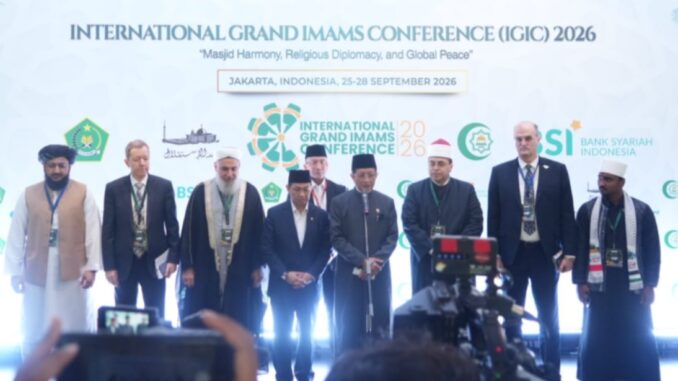
2026 IGIC Conference in Jakarta Sparks ‘Jakarta Understanding’ Declaration as Leaders from 39 Nations Unite for World Peace!”
JAKARTA, KalderaNews.com – The historic 2026 International Grand Imams Conference (IGIC), held in Jakarta from September 25–27, 2026, officially concluded with the birth of a monumental agreement titled “Jakarta Understanding.”
This joint declaration serves as a crucial foundation for strengthening religious diplomacy and asserting the strategic role of imams and mosques in realizing global peace.
The international conference was attended by 49 delegates from 39 countries, comprising Grand Imams, Grand Muftis, as well as leaders of places of worship and religious figures from Europe, the Americas, Africa, and Asia.
RELATED TOPICS:
- When House Keys Can No Longer Open the Door Home for Ukrainian Children
- Indonesia’s 2026 Forest Fires: 1,800+ Hotspots Spark SEA Haze Crisis
- When Church Bells Meet the Bedug: 120 Asian Bishops Walk Jakarta’s Tunnel of Friendship
At the closing of IGIC 2026, the delegates agreed to establish a permanent global organization named The International Assembly of Mosque Imams (IAMI) and appointed the Minister of Religious Affairs of the Republic of Indonesia and Grand Imam of the Istiqlal Mosque, Nasaruddin Umar, as the first President of IAMI.
Imams As Ambassadors of Peace
Minister of Religious Affairs Nasaruddin Umar emphasized the importance of strengthening the role of imams as ambassadors of peace and humanitarian bridges amidst rising global conflicts.
Opening the 2026 International Grand Imam Conference (IGIC) in Jakarta on Saturday (September 26, 2026), the Minister called for mosques to be utilized as meeting points to foster dialogue and strengthen social harmony.
An imam’s closeness to the community is considered a powerful social asset due to their routine interactions, occurring at least five times a day.
This high frequency of engagement surpasses that of government officials or other community organization leaders, giving imams a uniquely strategic position to convey messages of peace.

Therefore, the Minister encouraged expanding the role of imams beyond religious rituals into social and humanitarian spheres.
When formal diplomacy often reaches a standstill in halting wars, a new approach rooted in moral and humanitarian values offered by religious leaders can provide an alternative solution.
The Minister stressed that human values are universal and transcend boundaries of religion, ethnicity, or nationality.
Using the language of faith to resonate with shared humanity is believed to help de-escalate tensions and serve as an effective common ground when addressing regional and international conflicts.
In addition to building peace among people, the role of imams is also linked to environmental preservation through an ecotheological approach. Religious discourse is expected to raise awareness among the public and natural resource managers to prevent environmental degradation and overexploitation.
To broaden this positive impact, the Minister plans to initiate interfaith gatherings by inviting leaders from non-Muslim places of worship to discuss shared humanitarian and environmental issues. During the event, he also introduced the concept of ukhuwah makhluqiyah, representing a sense of brotherhood among all of God’s creations.
The IGIC 2026 event, carrying the theme “Mosque Harmony, Religious Diplomacy, and Global Peace,” was attended by 49 international delegates from 39 countries. Held from September 25 to 28, 2026, the forum brought together Grand Imams, Grand Muftis, and global religious figures to discuss religious diplomacy, global peace, and the economic potential of mosques.
Transformation of Mosque Roles and Humanitarian Diplomacy
Minister of Religious Affairs Nasaruddin Umar emphasized that the “Jakarta Understanding” arose from a shared awareness that religious diplomacy possesses the moral strength to complement formal diplomacy between nations.
Amid global conflicts and complex social phenomena, mosques must be restored to their true, essential function as in the era of the Prophet Muhammad SAW—not merely as places of ritual worship, but as hubs of civilization, community empowerment, and human protection.
“Through the Jakarta Understanding, the Grand Imams convey a message that peace is a shared responsibility of humanity and that mosques can serve as a bridge connecting differences,” stated Minister Nasaruddin Umar.
Full Text Jakarta Understanding Declaration
International Grand Imams Conference (IGIC) 2026 Jakarta, Indonesia
From Jakarta, Indonesia, we, the Grand Imams, convey a message to the global community that peace is a shared responsibility of all humanity; that mosques can serve as bridges connecting differences; that religious diplomacy can strengthen diplomacy among nations; and that a peaceful future for the world can only be built through the spirit of humanity and brotherhood that transcends the boundaries of nations, cultures, and beliefs.
Therefore, we, the Grand Imams from around the world, call upon all Mosque Imams:
- To Carry Out Strategic Roles: Not only as leaders of worship, but also as conflict mediators, unifiers of diversity, and moral guides for society. Mosque imams also actively play a role in turning religious institutions into open, inclusive community spaces oriented toward humanity and civilization.
- To Be Agents of Peace: Committed to protecting human dignity regardless of ethnic background, religion, nationality, or gender. Pioneering character education, instilling values of moderation, tolerance, love, compassion, respect for differences, and strengthening digital literacy.
- To Fight for Social Justice: Guaranteeing the protection of human rights by creating a safe, just, and welcoming environment for children, women, persons with disabilities, minority groups, and other vulnerable groups, as well as supporting family resilience.
- To Drive Religious Diplomacy: Encouraging interfaith dialogue to prevent conflicts, build mutual trust, and strengthen global reconciliation. Mosque imams also stand on the front lines in rejecting all forms of extremism, violence, misuse of religion, hoaxes, and hate speech.
- Ecotheological Commitment: Building awareness to preserve the balance of nature, halting environmental destruction, and encouraging mosques and religious communities to become pioneers of Earth’s sustainability for future generations.
- Global Collaboration: Fostering global collaboration with international institutions, governments, and civil society to create a just, dignified, and peaceful world for all humanity.
- Support for Palestinian Independence: Reaffirming full support for the right of the Palestinian people to self-determination, protecting civilians, upholding international law, and achieving sustainable independence, justice, peace, and dignity for Palestine.
Getting to Know IAMI
IAMI was formed in response to numerous inputs from various imams, muftis, and delegates from 46 countries during the IGIC 2026 forum.
IAMI is an international organization that positions the mosque not merely as a place of worship, but also as a hub for education, community development, social solidarity, moral guidance, and peacebuilding.
Imams today face massive challenges, including religious intolerance, social fragmentation, environmental degradation, youth issues, poverty, misinformation, humanitarian crises, as well as the need for constructive interfaith and international dialogue.
IAMI, which translates into Indonesian as Majelis Grand Imam Internasional, serves as a permanent international platform. Through this organization, recognized imams and religious leaders can exchange knowledge, strengthen cooperation, promote peaceful religious discourse, and contribute to the well-being of humanity.
The vision of IAMI is to become a leading global platform that unites imams in promoting harmonious communities, responsible religious leadership, human dignity, and lasting peace.
The President will act as the principal representative of IAMI, with responsibilities that include: representing IAMI at the international level, leading the Supreme Council, heading international diplomatic and religious engagements, promoting the assembly’s mission, and coordinating with major international religious institutions. The President serves a term of three years, which can be extended once.
IAMI operates on five strategic pillars and programs: Mosque Harmony, Leadership of Imams, Religious Diplomacy, Global Peace and Humanitarian Action and Sustainable Mosques and Communities
IAMI is headquartered in Jakarta as its permanent secretariat and administrative center. Meanwhile, IAMI regional offices are located in Kuala Lumpur (Asia), Cairo (Middle East), Nairobi (Africa), London (Europe), New York (North America), Rio de Janeiro (South America), and Canberra (Australia and Pacific).
IAMI will hold monthly virtual meetings among the world’s Grand Imams to collectively discuss issues concerning the global community.
The Minister of Religious Affairs hopes that in the next phase, organizers can invite leaders of other places of worship, such as churches, synagogues, and templesto discuss humanitarian and environmental challenges.
“We will not engage in practical politics or issues that disrupt mutual comfort, but rather unify our understanding that humanity is one. We take inspiration from the Prophet Muhammad SAW, who during his lifetime was able to bridge all differences so that conflicts disappeared,” he stated.
Concrete Steps Post-Conference
As a concrete commitment to the Jakarta Understanding, IAMI, based in Jakarta, will hold monthly virtual dialogues among Grand Imams from various continents.
Moving forward, this forum will also expand its scope of dialogue by inviting leaders from various non-Muslim places of worship to address crucial humanitarian issues, climate crisis management, and the preservation of the Earth.
Check out other KalderaNews.com news and articles on Google News
*If you found this article helpful, please share it with your family, friends, and colleagues. Interested in collaborating with KalderaNews.com? Please contact us via WhatsApp (0812 8027 7190) or email: kalderanews@gmail.com.


Leave a Reply