

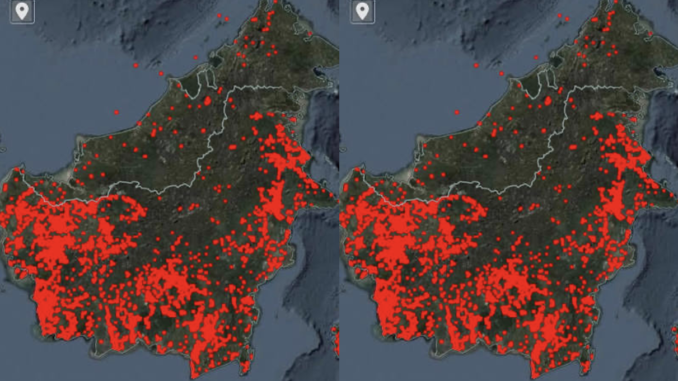
Over 1,800 hotspots in Borneo trigger a severe SEA haze crisis, driving public health risks and calls for environmental reform.
JAKARTA, KalderaNews.com – Wildfires have once again swept across Indonesian Borneo during the 2026 dry season. Official satellite monitoring via NASA-NOAA 20 recorded 1,842 hotspots across five provinces as of August 21, 2026.
RELATED TOPICS:
- Indonesian Students Threaten to Launch “Reformation Part 2”: Jakarta on High Alert
- Indonesia-Singapore Boost Education & AI Collaboration
- 90 Indonesian Students Awarded Erasmus Mundus Scholarships 2026
BNPB’s Acting Head of Disaster Data, Berton SP Panjaitan, confirmed that 1,832 hotspots show medium confidence levels, while 10 show high confidence levels. Total burned area in 2026 has crossed 285,000 hectares, with 182,000 hectares destroyed in July alone.
| Province | Hotspot Count | Confidence Classification |
| Central Kalimantan | 976 Hotspots | 968 Medium, 8 High Confidence |
| West Kalimantan | 489 Hotspots | 487 Medium, 2 High Confidence |
| East Kalimantan | 237 Hotspots | All Medium Confidence |
| South Kalimantan | 125 Hotspots | All Medium Confidence |
| North Kalimantan | 15 Hotspots | All Medium Confidence |
Expert Critique: Policy Failures & Unchecked Monoculture
Environmental experts and lawmakers emphasize that the crisis is a man-made system failure rather than an unavoidable natural disaster.
WALHI: Reactive Emergency Response Over Structural Prevention
Former Executive Director of WALHI South Kalimantan, Kisworo Dwi Cahyono, publicly accused the government of systemic negligence.
“The government continues to fail in disaster management. Under Disaster Management Laws, state duty spans mitigation, emergency response, and post-disaster rehabilitation. Yet authorities only act when smoke appears. Rain brings floods; dry seasons bring haze. Why does this cycle persist?” stated Kisworo.
Kisworo pointed out that widespread monoculture plantation permits have ruined natural ecosystems and questioned the government’s minimal budget allocation for environmental restoration.
Indonesian Parliament (DPR RI): Focus on Corporate Land Clearing
House Commission IV lawmaker Daniel Johan noted that the primary driver remains human activity, specifically land clearing by corporate and non-corporate entities, exacerbated by Godzilla El Niño weather conditions.
“We warned the Ministry of Forestry a year ago to deploy detailed mitigation plans. Parliament is awaiting official data regarding fire acreage inside corporate concessions to enforce accountability,” Johan stated.
Field Realities: Subterranean Peat Fires & Remote Terrain
On-the-ground suppression faces extreme logistical obstacles. BPBD Kotawaringin Timur Head, Multazam, reported that active blazes have moved far beyond urban boundaries.
- Logistical Obstacles: Firefighters rely on three-wheeled vehicles or foot travel to reach blazes, often arriving at sites completely devoid of water sources.
- Peatland Dynamics: Unlike structural fires extinguished in 1–2 hours, subterranean peat fires burn deep underground and require over 9 hours of continuous dousing per site.
- Joint Air-Ground Operations: BNPB uses aerial water-bombing helicopters to knock down top flames, followed by ground crews digging out underground embers.
Social & Public Health Crisis Across Borders
Public Health Emergency
In Banjarbaru, South Kalimantan, acute respiratory infection (ISPA) cases surged past 23,646 between January and August 2026. Chronic exposure to PM2.5 particulates poses severe long-term risks of stroke, heart disease, and lung cancer—disproportionately affecting infants, pregnant women, and the elderly.
Educational & Economic Disruption
Thick haze reduced visibility to 1–10 meters in places, forcing schools to delay starting hours or pivot to online learning. Smallholders faced immediate losses, such as local poultry farmer Abdul Kholik, who lost Rp50 million when airborne embers (kelelatu) ignited his farm, killing 230 chickens.
Demands for Reform and Accountability
Civil society groups and student unions, led by BEM PTNU, have issued an ultimatum to the central government regarding environmental governance.
Core Demands Submitted to Government:
- Ministry Leadership Review: Conduct a total performance audit of the Ministry of Environment and Forestry (KLHK). The Minister must resign if structural reforms fail.
- Prosecution of Corporate Aktor: Fully investigate and prosecute corporate financiers behind illegal land clearing by burning.
- Strict Legal Enforcement: Enforce non-discriminatory penalties against both individual arsonists and corporate concession holders.
Transboundary Impact: Haze Forces School Closures in Sarawak, Malaysia
The cascading impact of Kalimantan’s forest and land fires has crossed international borders, severely disrupting the education sector in Sarawak, Malaysia.
As the Air Pollution Index (API) surged into unhealthy levels, the Sarawak State Education Department (JPN) issued an emergency directive suspending face-to-face classes on August 20–21, 2026.
This temporary shutdown affected 509 primary schools and 82 secondary schools, forcing 197,323 students to shift to remote learning to protect them from the hazardous toxic haze.
Check out other KalderaNews.com news and articles on Google News
*If you found this article helpful, please share it with your family, friends, and colleagues. Interested in collaborating with KalderaNews.com? Please contact us via WhatsApp (0812 8027 7190) or email: kalderanews@gmail.com.



Leave a Reply