

MSCI threatens to demote Indonesia’s stock market to Standalone status. Discover the key reasons behind this global blow.
The Path To Financial Freedom, EduFulus — Global financial markets were rattled by a surprise decision from international index provider Morgan Stanley Capital International (MSCI).
The New York-based firm officially announced that Indonesia’s stock market is “no longer worthy” of its Emerging Market classification.
MSCI noted that reforms to address structural issues on the domestic exchange have failed to demonstrate sufficient progress.
RELATED TOPIC: MSCI Announces May 2026 Index Review: 101 Stocks Dropped from Global Index
In fact, MSCI emphasized that even a downgrade to Frontier Market status would fail to reflect the severity of the market’s underlying problems.
Instead, MSCI has launched a global market consultation running until April 2027 to reclassify Indonesia directly to Standalone Market status—an isolated category that would group Indonesia alongside countries facing extreme economic or geopolitical crises, such as Lebanon, Palestine, and Argentina.
“Significant concerns remain around market dysfunction. Accordingly, MSCI considers Indonesia’s continued classification as an emerging market no longer appropriate,” MSCI stated in an official announcement.
Core Reasons Behind MSCI’s Move: Stock Manipulation to Free-Float Opacity
MSCI’s threat to isolate Indonesia’s equity market stems from fundamental structural shortcomings within the exchange, rather than fiscal health or broader macroeconomic slumps.
Angus Mackintosh, an ASEAN specialist at Aletheia Capital in Singapore, noted that while MSCI’s proposed move is heavy-handed, it points directly to the core problem troubling international investors:
“The main problem is Indonesia’s failure to sanction those obviously involved in stock manipulation,” Mackintosh explained.
The key structural issues cited by MSCI and market analysts include:
Coordinated Trading & Price Manipulation: Rampant price rigging and manipulation (particularly involving conglomerate-backed equities) that undermine market integrity.
Opacity in Ownership: Inadequate transparency regarding actual share ownership and genuine free float data.
Weak Market Governance: Insufficient regulatory enforcement and weak protection mechanisms for minority and institutional investors.
Threat of Mass Capital Outflow & World’s Worst Stock Performance
This decision serves as a major wake-up call for Indonesia’s capital market. Because billions of dollars in global passive index funds track the MSCI Emerging Market Index, a downgrade to Standalone Market status would force funds to exclude Indonesian equities from their portfolios.
This reclassification carries the risk of triggering billions of dollars in forced selling by global asset managers.
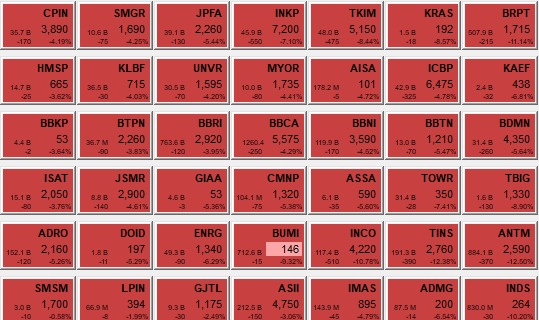
Even prior to MSCI’s latest announcement, Indonesia’s equity market was already the world’s worst performer in 2026. The benchmark Jakarta Composite Index (JCI / IHSG) has tumbled over 30% year-to-date, accompanied by net foreign capital outflows exceeding $4.7 billion.
The market pressure was further compounded after credit rating agencies Moody’s and Fitch revised Indonesia’s sovereign outlook to negative.
Response from Exchange Authorities & Risk of Trading Halts
In response to MSCI’s statement, Jeffrey Hendrik, CEO of the Indonesia Stock Exchange (IDX), stated that the exchange has taken concrete steps to improve market transparency and will seek further clarification regarding the basis of MSCI’s evaluation.
However, the threat of panic selling driven by negative global sentiment increases the likelihood of triggering the exchange’s automatic Trading Halt protocols.
Under Indonesia’s Financial Services Authority (OJK) regulations, circuit breakers operate on the following thresholds:
Level 1 (30-Minute Trading Halt): Triggered if the JCI plummets by 5% within a single trading day.
Level 2 (30-Minute Trading Halt): Triggered if the index drops by 10% after trading resumes.
Level 3 (Full Trading Suspend): Activated if the index plummets by 15%, halting all equity trading for the remainder of the session.
Investor Outlook
Market analysts advise investors to remain calm and analytical. With the consultation period running through April 2027 and the final decision scheduled for mid-2027, Indonesian market authorities still have a window of opportunity to implement key governance reforms and address free-float transparency before any downgrade is finalized.
RELATED TOPICS: TIAS MBA Circular Economy Field Trip in Amsterdam
* Let’s get smart about investing and trading with more educational articles from EduFulus on Google News. Plus, if you’re interested in collaborating with the EduFulus channel, feel free to reach out to our team via WA (0812 8027 7190) or email: kalderanews@gmail.com.
Leave a Reply