


JAKARTA, KalderaNews.com – In September 2025, we held a series of events titled KIGUMI in the Kampung: Japan-Indonesia Carpentry Exchange. This project aimed to share the traditional Japanese wood joinery technique of Kigumi within an Indonesian kampung through a mutual cultural exchange.
The project consisted of a Kigumi seminar, a Kigumi workshop, an exhibition, and a kampung walking event. It was organized by Kampung Kollektief, Architectural Actions Kikikeko, the Okabe Lab from The University of Tokyo, and the University of Indonesia, with the support of The Japan Foundation, Jakarta.
Kigumi (木組) is a traditional Japanese wood joinery technique. It is the art of assembling buildings and furniture by interlocking pieces of wood without the use of nails or metal fasteners.
RELATED TOPICS:
- How can we co-create more sustainable futures for kampungs in Jakarta by collaborating with its local communities?
- Nuffic Southeast Asia (SEA) Officially Launched, Titia Bredée: Time to Collaborate for the Future of the Region
- New Era of Collaboration with Southeast Asia, Nuffic SEA Strengthens Education and Knowledge Ties
This respectful approach creates remarkably resilient and flexible joints that can absorb the force of earthquakes, allowing buildings to sway and release energy.
Seminars, Workshops, and Exhibitions
The Kigumi seminar featured a foundational explanation of Kigumi via video and Zoom by Mr. Itou, a Japanese carpenter from Ito Tomohisa Co., Ltd. This was followed by an in-person introduction to Japanese carpentry tools and their usage, along with a demonstration of Kigumi techniques, by Daichi Yamashita, a young Japanese carpenter who traveled to Jakarta.
The Kigumi workshop was held in a community space within the kampung. With materials generously donated by Waste4Change, an Indonesian waste recycling startup, participants collaborated with Yamashita Daichi and local kampung carpenters to build chairs using Kigumi techniques.
As a form of cultural exchange between Japan and Indonesia, the chairs were crafted not only with Kigumi but also incorporated building materials commonly used in Indonesia. The process was guided by both the Indonesian and Japanese carpenters, who shared their knowledge of their respective tools and methods with the participants.
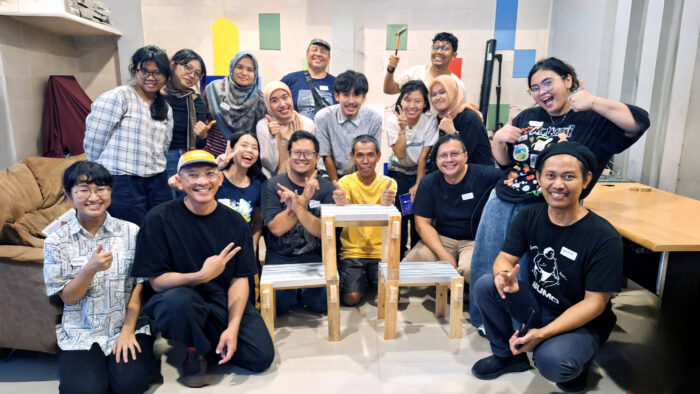
The exhibition and kampung walking event, held in collaboration with Ganggangan, focused not only on Kigumi but also on the history of the collaborative projects between The University of Tokyo, the University of Indonesia, and Kampung Cikini.
Throughout all stages of the project, with the cooperation of the Fujita Laboratory of Wood Structures at The University of Tokyo, opportunities were provided for participants to physically handle Kigumi samples and experience the technique firsthand.
Why “in the Kampung”? The Intersection of Tradition and Sustainable Futures
The reason this multifaceted project was specifically held “in the kampung” lies in the 14-year relationship that the University of Indonesia and The University of Tokyo have cultivated with Kampung Cikini. Furthermore, Kigumi and the kampung—two seemingly unrelated subjects—share a common thread: they both hold hints for a sustainable future.
Since 2011, the University of Indonesia and The University of Tokyo have continuously conducted joint architectural student workshops and projects to build public and communal spaces in Kampung Cikini.
Local residents and students in site for UI-UTokyo Joint Workshop, photo by Hajime Ishikawa
Professor Akiko Okabe of The University of Tokyo states that the reason for over a decade of practical engagement in Kampung Cikini is that the kampung holds clues for the future lifestyles of people across the globe.
The residents of the kampung share resources and space, establishing a lifestyle with a low environmental impact, and their way of life offers insights into what a sustainable future could look like. While the high-density living arrangement of a kampung is often perceived as a problem to be solved, it actually conceals valuable lessons to be learned.
The same can be said for the technique of Kigumi. It is a traditional technique that predates the high-environmental-impact lifestyles of the modern era, and it can be a key to creating circular, sustainable architecture using timber. The kampung was the perfect setting to present Kigumi not merely as a traditional craft to be preserved and admired, but as a living, sustainable technology to be used in daily life.
The KIGUMI in the Kampung project was rooted in the hope that by combining the hints for a low-impact, sustainable way of life from the kampung with Kigumi as a living technology, we could create an opportunity to think about a better future. (By: Kitazato Mone and Anastasia Dinda Ciptaviana)
Cek Berita dan Artikel KalderaNews.com lainnya di Google News
*Jika merasa artikel ini bermanfaat, silakan dishare pada saudara, sahabat dan teman-temanmu. Tertarik menjalin kerjasama dengan KalderaNews.com? Silakan hubungi WA (0812 8027 7190) atau email: kalderanews@gmail.com



Leave a Reply